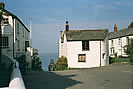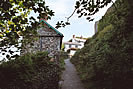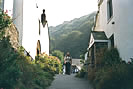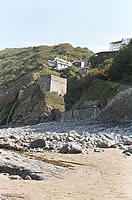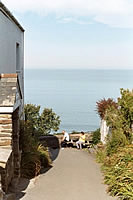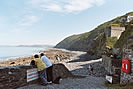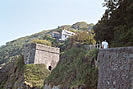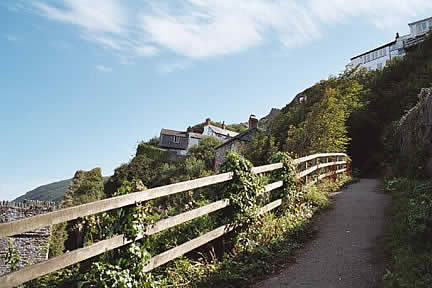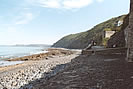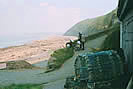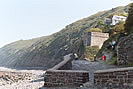



The steep cliff path down to the beach now has a good tarmac surface.
The landslip in 1989 blocked this path for some months. The views of Bideford
Bay are spectacular from here and on a clear day you can get a good view
of Lundy Island to the north, Clovelly & the headland, Gallantry Bower,
to the west and Peppercombe/Greencliffe to the east. Part way down is
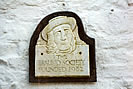
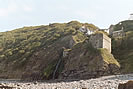
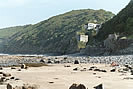
the "Look-Out Cottage", a two roomed building, believed to be
used originally as a fisherman's store. It was owned by the Walland Carey
Estate and rented out to various tenants including Arthur Thomas Braund
who took over the tenancy in 1907 for two years. By 1913, the tenant was
Mrs E Ackland, a doctor's wife from Bideford. From the 1920's up until
early 1970's the building was used as a studio by two local artists, Mrs.
Ackland's daughter Judith and her friend, Mary Stella Edwards who renamed
it "The Cabin". The tenancy passed to Judith in 1938 and, when
the Walland Carey Estate was sold in 1948, Judith Ackland, as the sitting
tenant, bought "The Cabin" for six hundred and twenty five pounds.
The Cabin was in use by the pair until Judith's death in 1971. Their watercolour
paintings of the village and local scenes are on display at the Burton
Art Gallery in Bideford. It is quite amazing that although this is one
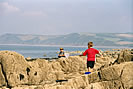
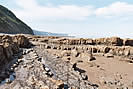
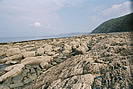
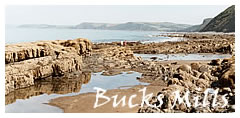
stretch of coastline, each cove has its own unique qualities. Peppercombe
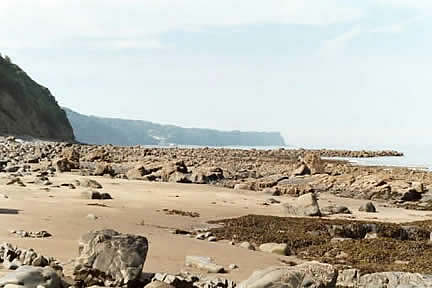
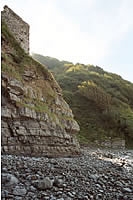
is noted for its red cliffs, however the pebbles give way to hard molten
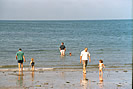
rock formations here and one reason the beach is popular with families
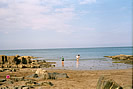
with children is "The Gut" or "Gutway". The sandy
inlet was created when the rock was blasted by gunpowder by Richard Cole,
Lord of the Manor of Bucks, in Elizabethan times when he was building
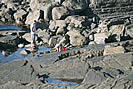
the harbour. At low tide, the large bolders are the remains of what once
was the "Old Quay" The effigy of Richard Cole lies in the north
wall of All Hallows Church in Woolfardisworthy. The large rock promontory
is "The Gor". "Local Legend says that this rocky spit is
the remains of a causeway built by the Devil to enable him to get to Lundy
Island: when the stick of his Devon shovel broke, he abandoned the enterprise".
In the 18th century Bideford's main import was of culm, a mixture of anthracite
and limestone which was then burnt in the local Lime Kilns. The lime fertiliser
produced was used to "sweeten" the North Devon soil. There were
seven lime kilns along the Torridge Estuary from Appledore to Bideford
with nine beyond the Long Bridge. Kilns were then built along the coast
and the remains of East Kiln at Bucks Mills, which dates from 1760, was
built by Robert Davey. Fishing was also once as main industry for Bucks
Mills with herring, mackerel, whiting, lobsters and prawns being the most
popular catches. When fishing declined and the lime kilns stopped working,
villagers risked sailing the seventeen miles of open sea to Lundy to work
in the island's granite quarry.
Historical Information - D. Hubbard-Fielder, The Story of Bucks
Mills & Bucks Cross, available from Bideford Library and information
supplied by the Braund Society from their publication, Who lived in
Cottages like these? - the inhabitants of Bucks Mills.